Pure mathematics is, in its way, the poetry of logical ideas. --- Albert Einstein ...Economics is nothing but Mathematics -Dr.Ahsan Abbass...Symmetry is Ornament of Mathematics-Zulfiqar Ali Mir...Law of Nature are But Mathematical Thoughts of God - Euclid (Father of Geometry)...Mathematics is about Number and pattern among these nos.-Sir Zulfiqar A Mir,... Number Theory is Foundation of Mathematics-Sir Zulfiqar Ali Mir
Showing posts with label A'Level. Show all posts

Friday, 8 June 2012

Combinations and Permutations

Combinations and Permutations


In English we use the word "combination" loosely, without thinking if the order of things is important. In other words:
"My fruit salad is a combination of apples, grapes and bananas" We don't care what order the fruits are in, they could also be "bananas, grapes and apples" or "grapes, apples and bananas", its the same fruit salad.


"The combination to the safe was 472". Now we do care about the order. "724" would not work, nor would "247". It has to be exactly 4-7-2.
So, in Mathematics we use more precise language:
If the order doesn't matter, it is a Combination.
If the order does matter it is a Permutation.


So, we should really call this a "Permutation Lock"!
In other words:
A Permutation is an ordered Combination.


Permutations

There are basically two types of permutation:
  1. Repetition is Allowed: such as the lock above. It could be "333".
  2. No Repetition: for example the first three people in a running race. You can't be first and second.

1. Permutations with Repetition

These are the easiest to calculate.

In other words, there are n possibilities for the first choice, THEN there are n possibilites for the second choice, and so on, multplying each time.

n × n × ... (r times) = nr


Example: in the lock above, there are 10 numbers to choose from (0,1,..9) and you choose 3 of them:
10 × 10 × ... (3 times) = 103 = 1,000 permutations


So, the formula is simply:
nr
where n is the number of things to choose from, and you choose r of them
(Repetition allowed, order matters)

2. Permutations without Repetition

In this case, you have to reduce the number of available choices each time.

For example, what order could 16 pool balls be in?
After choosing, say, number "14" you can't choose it again.
So, your first choice would have 16 possibilites, and your next choice would then have 15 possibilities, then 14, 13, etc. And the total permutations would be:
16 × 15 × 14 × 13 × ... = 20,922,789,888,000
But maybe you don't want to choose them all, just 3 of them, so that would be only:
16 × 15 × 14 = 3,360
In other words, there are 3,360 different ways that 3 pool balls could be selected out of 16 balls.


where n is the number of things to choose from, and you choose r of them
(No repetition, order matters)
How many ways can first and second place be awarded to 10 people?
10! = 10! = 3,628,800 = 90


(10-2)! 8! 40,320
(which is just the same as: 10 × 9 = 90)


Combinations


There are also two types of combinations (remember the order does not matter now):
  1. Repetition is Allowed: such as coins in your pocket (5,5,5,10,10)
  2. No Repetition: such as lottery numbers (2,14,15,27,30,33)

web


Saturday, 3 March 2012

Mechanics

Mechanics

Engineering Mechanics

Engineering Mechanics is divided into two: Statics and Dynamics.

Statics includes the following topics: resultant of force system; equilibrium of force system; cables; friction; trusses; frames; centroid; center of gravity; and moment of inertia.
Dynamics will cover the following topics: kinematics, dynamics, kinetics, work-energy equation, impulse and momentum, and mechanical vibrations.

Principles of Statics

Statics is a branch of mechanics which studies the effects and distribution of forces of rigid bodies which are and remain at rest. In this area of mechanics, the body in which forces are acting is assumed to be rigid. The deformation of the body is treated in Mechanics and Strength of Materials.
Topics in Statics:
  • Resultant of Force System
  • Equilibrium of Force System
  • Analysis of Trusses
  • Cables
  • Friction
  • Centroids and Centers of Mass
  • Moments of Inertia


Advances in thermodynamics led to the development of industrialization; and
Advances in Mechanics inspired the development of calculus

File:Archimedes-screw one-screw-threads with-ball 3D-view animated small.gif


Mechanics (Greek) is the branch of physics concerned with the behavior of physical bodies when subjected to forces or displacements, and the subsequent effects of the bodies on their environment.


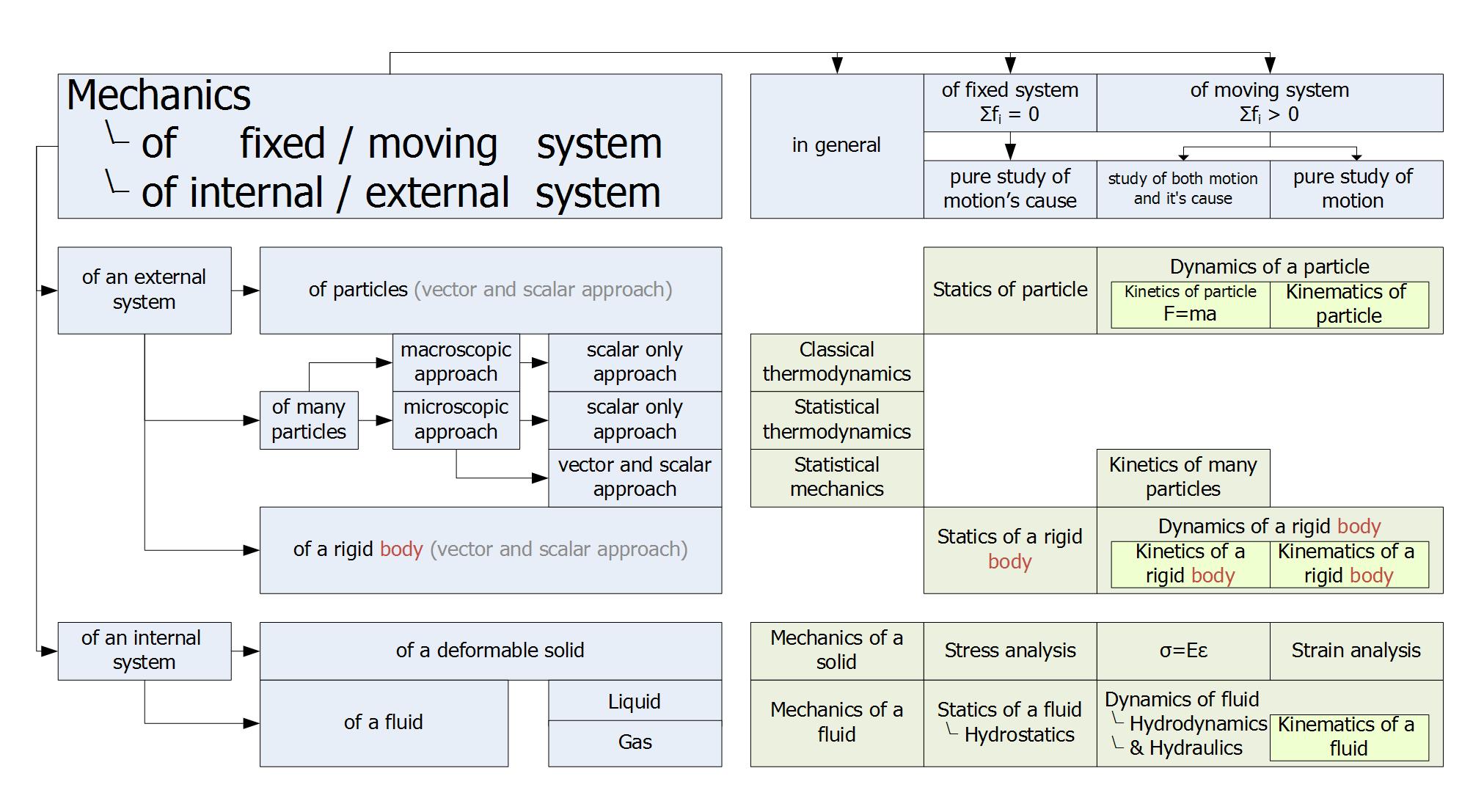
The major division of the mechanics discipline separates:

Classical mechanics originated with Isaac Newton's laws of motion in Principia Mathematica, while quantum mechanics didn't appear until 1900.


File:Mechanics Overview Table.jpg

Classical Mechanics:

The following are described as forming Classical mechanics:

Quantum mechanics

The following are categorized as being part of Quantum mechanics:
Professional organizations
File:Pahoeoe fountain original.jpg

This parabola-shaped lava flow illustrates the application of Mathematics in Physics – in this case,
Galileo's law of falling bodies

File:Mathematical Physics and other sciences.png
The distinction between Mathematics and Physics is clear-cut,
but not always obvious, especially in Mathematical Physics

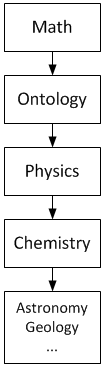
File:Physics and other sciences.png

Mathematics and Ontology are used in Physics.
Physics is used in Chemistry and Cosmology

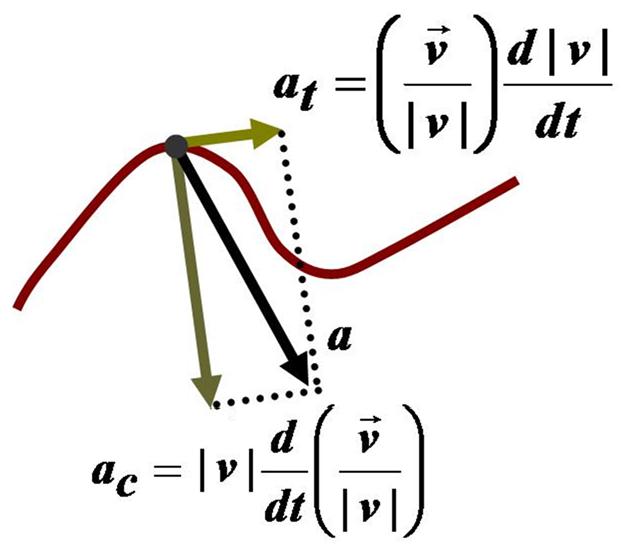
File:Acceleration components.JPG

Physics involves modeling the natural world with theory, usually quantitative. Here, the path of a particle is modeled with the mathematics of calculus to explain its behavior: the purview of the branch of physics known as mechanics


Physics 1
Mechanics Overview


Mechanics is the branch of Physics dealing with the study of motion

No matter what your interest in science or engineering, mechanics will be important for you - motion is a fundamental idea in all of science.

Mechanics can be divided into 2 areas - 
  1. kinematics, dealing with describing motions, and 
  2. dynamics, dealing with the causes of motion.

Physics 1 Mechanics topics include:

Guide lines on resolving:

Always aim to resolve in the direction that an object is moving.
If it is moving up a plane, resolve up the plane, if it is moving down the plane then resolve down the plane.
If you resolve in the opposite direction to motion then you will generally find yourself getting into all sorts of problems over acceleration having to be negative.
State the direction you are resolving by using R(left), R(up the plane) etc. Arrows inside the brackets can be used. It makes it clear to the person marking your work what you are intending to do.


Simple machine

A simple machine is a mechanical device that changes the direction or magnitude of a force. In general, they can be defined as the simplest mechanisms that provide mechanical advantage (also called leverage).
Usually the term refers to the six classical simple machines which were defined by Renaissance scientists:
A simple machine is an elementary device that has a specific movement (often called a mechanism), which can be combined with other devices and movements to form a machine.
Between the simple machines and complex assemblies, several intermediate classes can be defined, which may be termed "compound machines" or "machine elements".

The mechanical advantage of a compound machine is simply the product of the mechanical advantages of the simple machines of which it is composed.